
The short answer
To price a custom home build accurately, break the estimate into five visible categories: hard costs, soft costs, general conditions, contingency, and overhead and profit. Price each one against current, job-specific data and real subcontractor quotes. Then size contingency to the job's actual risk, typically 5% on a well-documented project up to 15% or more on a complex one, and keep the estimate connected to the budget once the contract is signed.
A builder wins a bid at $850,000 on a 4,200-square-foot custom home. Six months in, the framing package comes in $22,000 over what was estimated, the site work uncovers rock that wasn't in the geotech report, and the "allowance" line for plumbing fixtures turns out to be about half of what the client actually wants to spend. None of these individual misses feels like a disaster in the moment. By closeout, they've added up to a job that made 4% margin instead of the 18% it was priced to make.
This is not a story about a bad builder. It's the default outcome of an estimating process built on gut feel, a handful of subcontractor quotes, and a spreadsheet that hasn't been meaningfully updated since the last job that went sideways. Pricing a custom home accurately is one of the hardest and most consequential skills in the business - get it wrong on the front end, and no amount of good field management can fully recover the margin on the back end.
This guide walks through how experienced custom builders actually price a job: what belongs in an estimate, where the number quietly goes wrong, how to size contingency correctly, and how to keep the estimate honest as the job moves from bid to signed contract to the field.
Why Estimating Errors Are So Expensive
An estimate isn't a guess dressed up in a spreadsheet - it's the number every other financial decision on the job gets measured against. The contract price, the draw schedule, the subcontractor budgets, the change order markup, the client's expectations: all of it traces back to the estimate. When the estimate is wrong, everything built on top of it is wrong too, and the error compounds rather than corrects itself.
Underestimate a custom home build by even 5%, and on an $850,000 job that's $42,500 - often the difference between the builder's entire target profit and a job that barely breaks even. Worse, that gap usually isn't discovered gradually. It shows up all at once, months into construction, when there's no room left to renegotiate the contract and the only options are absorb the loss or have an uncomfortable conversation with the client about scope.
Overestimate significantly, on the other hand, and the builder loses the bid to a competitor who priced it tighter - or wins it anyway and now has to defend a number that looks padded next to two other bids. Accurate estimating isn't about being conservative or aggressive. It's about being right, consistently, job after job.
The Real Cost Categories in a Custom Home Estimate
A complete estimate for a custom home build has to account for more than materials and labor. Builders who consistently price accurately break every job into the same core categories, every time:
- Hard costs. Site work, foundation, framing, exterior envelope, mechanical/electrical/plumbing rough-in, insulation, drywall, interior finishes, cabinetry, flooring, trim, paint. This is the largest bucket and the one most builders are reasonably good at pricing - if their historical cost data is current.
- Soft costs. Permits, architectural and engineering fees, surveys, geotech reports, impact fees, insurance, and financing costs. These get overlooked more often than they should, particularly on jobs where the builder didn't manage the design phase directly.
- General conditions. Superintendent time, temporary utilities, dumpsters, portable toilets, site security, project management overhead - the cost of running the job itself, separate from building it.
- Contingency. A dedicated reserve for the unknowns every custom project carries - unforeseen site conditions, price volatility, design gaps discovered mid-construction.
- Overhead and profit. The builder's actual business overhead (office, insurance, administrative staff) plus the target profit margin. This should never be buried inside other line items - it needs to be its own visible number.
Miss any one of these categories, or lowball it because "that's usually about right," and the estimate is wrong before a single subcontractor bid comes in.
The Estimating Process Step by Step
Accurate estimating isn't one calculation - it's a sequence, and skipping steps or doing them out of order is where most errors creep in.
- Start from real plans, not a napkin sketch. A meaningful estimate requires at minimum a set of schematic design drawings with dimensions. Estimating off a verbal description of "about 4,000 square feet, high-end finishes" produces a number with no real basis.
- Take off quantities discipline by discipline. Square footage of foundation, linear footage of framing, square footage of roofing, count of windows and doors - broken out by CSI division or your own standard cost code structure, not lumped into vague categories.
- Price against current, job-specific data - not last year's number. Material and labor costs shift constantly. An estimate built on a cost database that's twelve months stale is an estimate built on the wrong number from day one.
- Get real subcontractor pricing on the categories that carry the most risk. Framing, mechanical, electrical, and plumbing should get actual quotes, not historical averages, on anything but the smallest or most standardized project.
- Build in allowances for undecided selections - and price them realistically. An allowance that's set too low to make the total number look better is not an estimate, it's a trap that surfaces as a change order the moment the client picks anything above builder-grade.
- Add contingency sized to the actual risk profile of the job, not a flat percentage applied out of habit.
- Add overhead and profit as its own visible line, calculated the same way on every job so margin doesn't quietly erode from one project to the next.
- Review the total against your own historical cost-per-square-foot data for comparable work, as a sanity check before the number ever reaches the client.
Common Estimating Mistakes That Kill Margin
Even experienced builders fall into the same handful of traps:
- Reusing an old estimate as a template without updating the underlying costs. Material and labor pricing moves fast. A framing cost that was accurate eight months ago can be meaningfully wrong today.
- Setting allowances to win the bid, not to reflect reality. A $3,000 lighting allowance on a house where the client is clearly going to spend $9,000 isn't optimism - it's a change order waiting to happen, and it damages trust the moment it surfaces.
- Underpricing general conditions. Superintendent time and site overhead get treated as a rounding error instead of a real cost that scales with the length and complexity of the job.
- Applying a flat contingency percentage regardless of risk. A ground-up build on a site with unknown soil conditions and a gut renovation of an existing structure do not carry the same risk, and shouldn't carry the same contingency percentage.
- Burying overhead and profit inside line items instead of showing it separately. When margin isn't visible as its own number, it's the first thing that gets quietly negotiated away during value engineering.
- Not comparing the estimate to actual historical job costs. Builders who never close the loop between what they estimated and what a job actually cost keep repeating the same pricing mistakes, bid after bid.
How to Build Contingency Into Your Estimate Correctly
Contingency isn't padding, and it isn't a rounding buffer tacked on at the end - it's a calculated reserve for the specific uncertainty a given project carries. Sizing it correctly means asking real questions about the job, not applying the same number to every bid:
- Site conditions. Unknown soil, an older lot with no recent geotech data, or a tight urban site with limited access all justify higher contingency than a clean, well-documented lot.
- Design completeness. A project bid off schematic drawings carries more pricing risk than one bid off fully detailed construction documents. The less finished the design, the higher the contingency should be.
- Scope complexity. A straightforward rectangular floor plan with standard finishes carries less risk than a highly custom design with unusual structural elements or imported materials with long, unpredictable lead times.
- Market volatility. In periods of unstable material pricing or labor availability, contingency should reflect that reality rather than assume costs will hold steady for the length of the build.
A typical range for custom home contingency runs from 5% on well-documented, straightforward projects up to 15% or more on complex custom builds with incomplete design or challenging sites. The number should be defensible, not defaulted - and it should be visible to the client as its own line, not hidden inside the total.
From Estimate to Contract: Keeping Pricing Accurate as the Job Evolves
An accurate estimate at bid time is only half the job. The number has to stay accurate as the project moves from proposal to signed contract to actual construction - and this is where a lot of builders lose the thread.
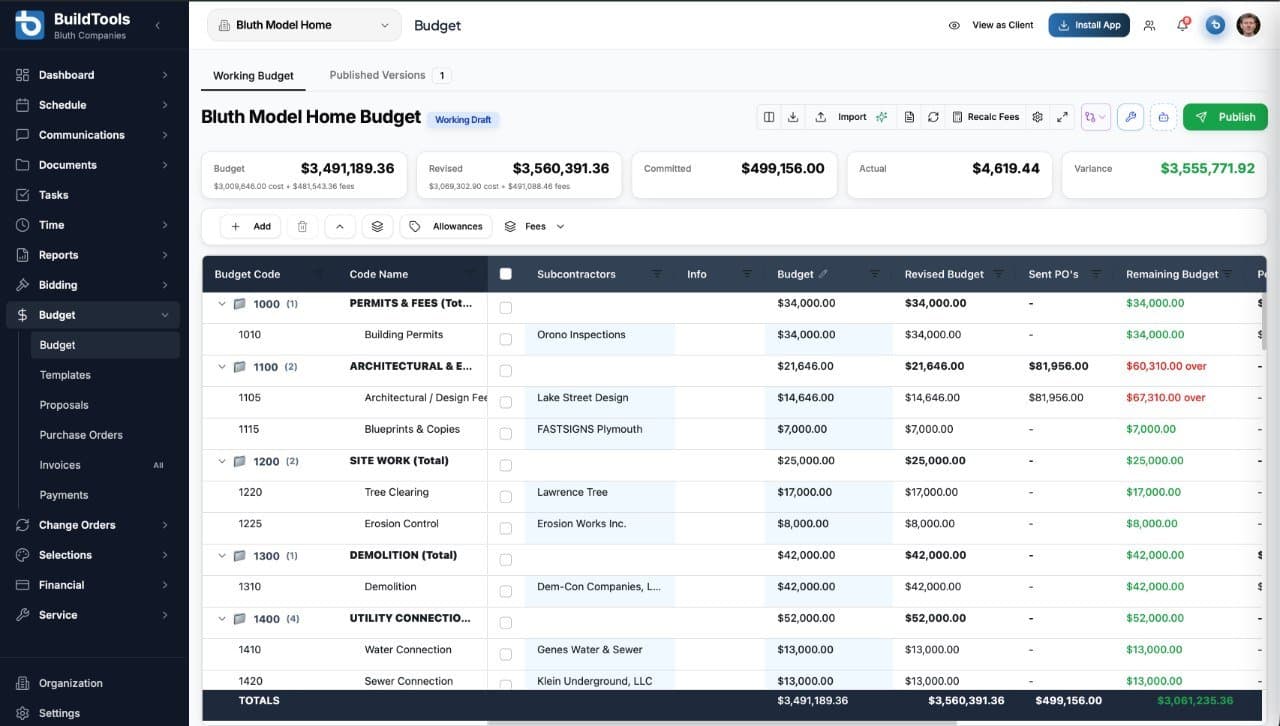
Once a bid is accepted, that estimate needs to convert cleanly into the working budget for the job - not get re-typed into a different system, where copy errors and dropped line items creep in. As selections get finalized, actual costs should replace allowance placeholders in real time, so the builder always knows the live variance between what was estimated and what's actually been committed. And every scope change from that point forward needs to run through a real change order process - tied back to the original estimate, not tracked separately where it's invisible until closeout.
This is where a lot of otherwise well-estimated jobs still lose margin: not because the original number was wrong, but because nothing kept it updated and visible as the job moved forward. The estimate becomes a historical document instead of a living budget. (We dig into this in why budget accuracy matters in construction.)
How BuildTools Helps Builders Estimate More Accurately
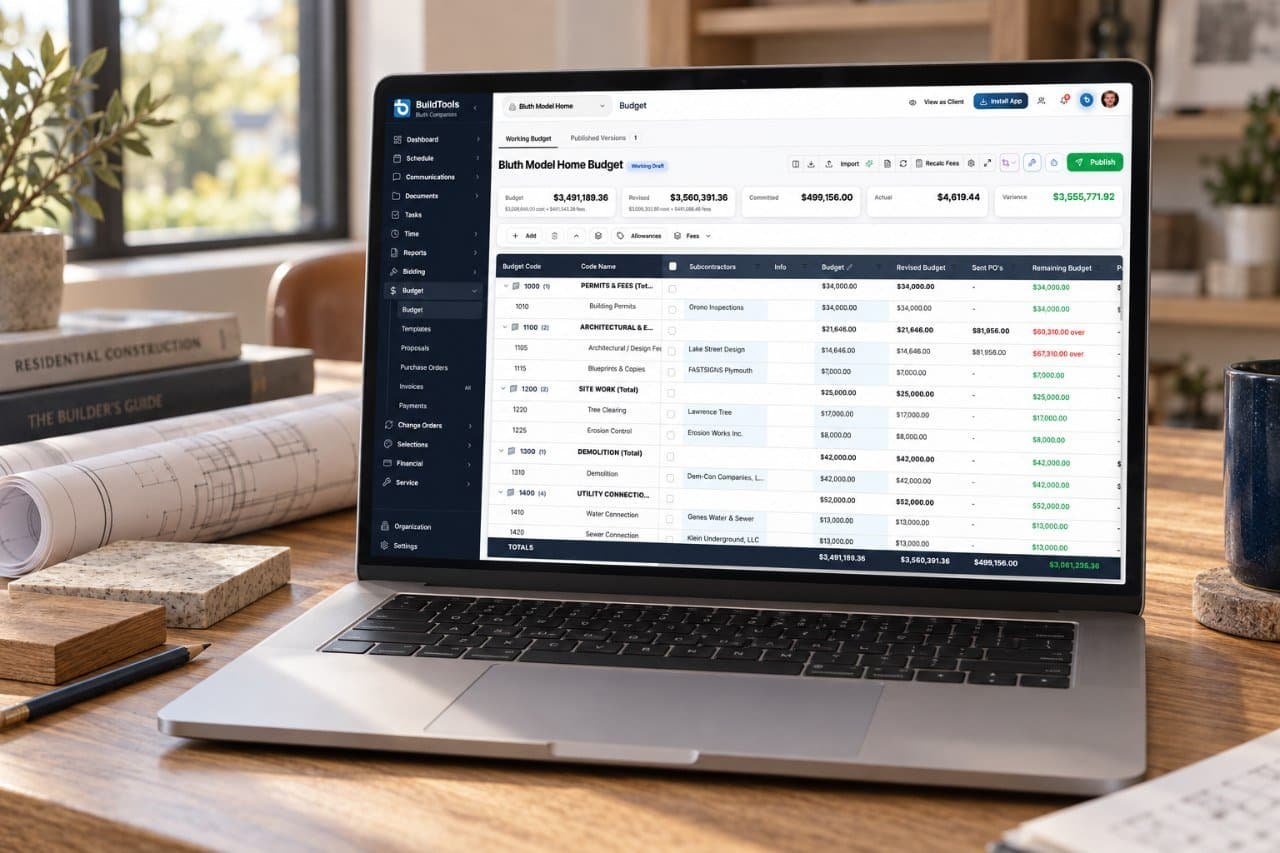
This is exactly the gap BuildTools is built to close. BuildTools is AI-first construction management software built specifically for custom home builders and remodelers. It's QuickBooks-native, and the new version launched in May 2026. It's, and it's designed around the reality that an estimate has to stay connected to the budget, the schedule, and the change orders for the entire life of the project - not just at bid time.
Inside BuildTools, an estimate is built from organized cost codes and line items (see construction budgeting software), not a loose spreadsheet, so nothing gets buried inside a vague category. Overhead and profit are tracked as their own visible line, applied consistently across every job, so margin doesn't quietly erode project to project. When a bid is accepted, that estimate becomes the live project budget directly inside BuildTools - there's no re-entry step where numbers get dropped or mistyped moving from proposal to contract.
From there, BuildTools keeps the number honest. As selections are finalized, actual costs replace allowance placeholders automatically. As change orders get approved, they flow straight into the budget with the correct markup applied, so the builder can see real-time variance (the core of construction job costing) between what was estimated, what's been committed, and what margin actually looks like at any point in the job - not just at closeout when it's too late to act.
The goal is fewer margin surprises at the end of a job, because the estimate isn't a static number that gets left behind the moment construction starts - it's a living part of the same system that runs the budget, the schedule, the selections, and the change orders.
A Simple Estimating Checklist You Can Use on Your Next Bid
You don't need new software to tighten this up on your next bid - though it helps considerably:
- Break the estimate into hard costs, soft costs, general conditions, contingency, and overhead/profit - as five visible categories, not one blended number.
- Price against current cost data, not a template pulled from a job bid a year ago.
- Get real subcontractor quotes on your highest-risk categories - typically framing, mechanical, electrical, and plumbing.
- Set allowances at realistic numbers, based on what similar clients actually spend, not what makes the bottom line look competitive.
- Size contingency to the actual risk of the job - site conditions, design completeness, scope complexity, and market volatility - not a flat habitual percentage.
- Show overhead and profit as its own line, calculated the same way every time.
- Compare the final number against your own historical cost-per-square-foot data before it goes to the client.
Do this consistently and track bid-to-actual on every job, and you'll see where your numbers drift so the next bid is tighter.
The Bottom Line
Pricing a custom home accurately isn't about a magic formula - it's about discipline: breaking the estimate into real categories, pricing them against current data, sizing contingency to actual risk, keeping overhead and profit visible, and then protecting that number as the job moves from bid to contract to the field. Builders who estimate well aren't the ones with the most experience gut-checking a number. They're the ones who treat the estimate as a living document connected to everything that happens after the contract is signed.
That discipline is difficult to sustain across a spreadsheet, a separate accounting system, and a change order process that lives somewhere else entirely. It's exactly what BuildTools was built to make automatic, so the number you bid stays close to the number you actually make.
Frequently asked questions
How do you price a custom home build?
Break the estimate into hard costs, soft costs, general conditions, contingency, and overhead and profit. Take off quantities from real plans, price them against current data and subcontractor quotes, then check the total against your own historical cost per square foot.
How much contingency should a custom home estimate include?
A typical range runs from 5% on well-documented, straightforward projects to 15% or more on complex custom builds with incomplete design or difficult sites. Size it to site conditions, design completeness, scope complexity and market volatility.
What are the biggest custom home estimating mistakes?
Reusing old estimates without updating costs, setting allowances low to win the bid, underpricing general conditions, using a flat contingency on every job, burying overhead and profit, and never comparing estimates to actual job costs.
Should overhead and profit be a separate line in an estimate?
Yes. Showing overhead and profit as its own line, calculated the same way on every job, keeps margin visible and harder to negotiate away during value engineering.
How do you keep an estimate accurate after the contract is signed?
Convert it into the working budget without re-typing it, replace allowances with actual costs as selections are made, and run every scope change through a change order process tied to the original estimate.
Does BuildTools work with QuickBooks?
Yes. BuildTools is QuickBooks-native: QuickBooks stays your accounting system, and BuildTools manages budgets, cost codes and approvals around it so costs are not re-keyed.
Related reading
- Why budget accuracy matters in construction
- BuildTools construction budgeting software: https://www.buildtools.com/features/construction-budgeting-software
- BuildTools construction takeoff software: https://www.buildtools.com/features/construction-takeoff-software
- BuildTools QuickBooks job costing: https://www.buildtools.com/features/quickbooks-job-costing-for-builders