
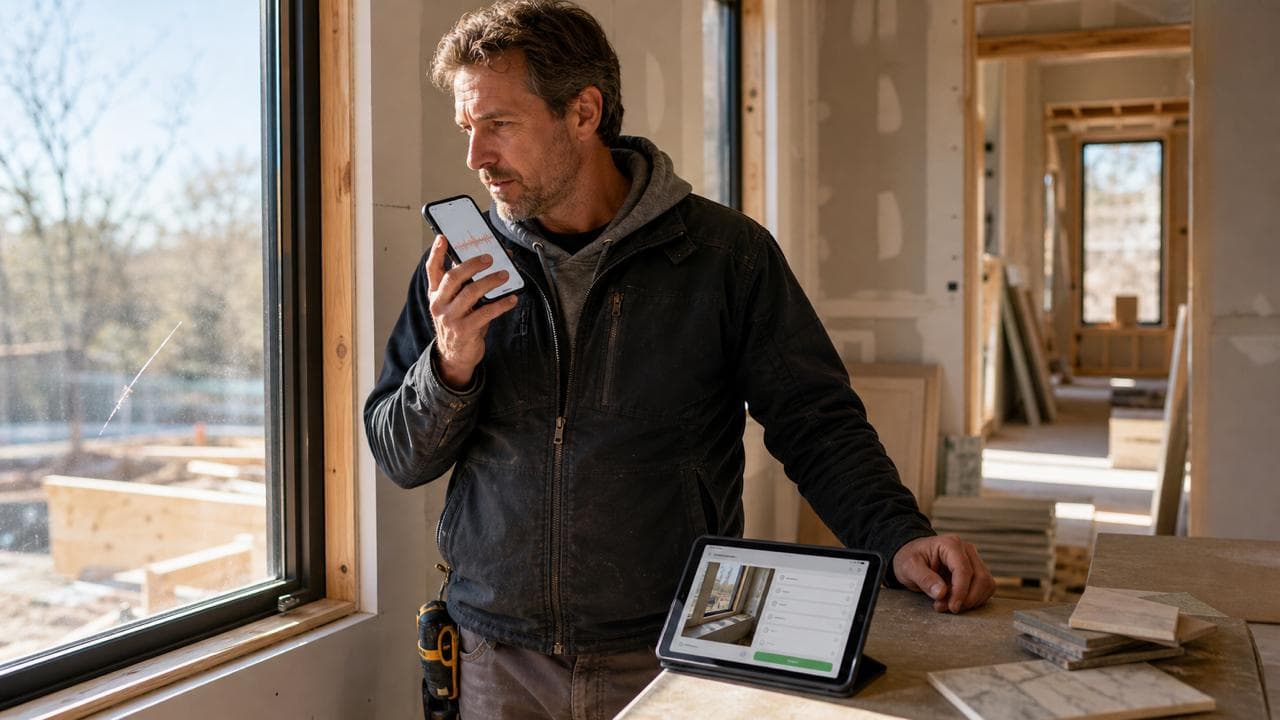
A superintendent is standing in the primary bath, looking at a scratched window. He knows exactly what needs to happen: punch item, assign it to the window supplier, target next Friday.
Here's what his software expects him to do: remember it. Get back to the truck. Open a laptop, navigate to the right project, find the punch list module, click "add," fill out six fields, search for the vendor, set the date, save.
Here's what he should be able to do: say it.
"Add a punch item for scratched glass in the primary bath window, assign it to the window supplier, target next Friday."
Done. Draft created, linked to the record, waiting for review.
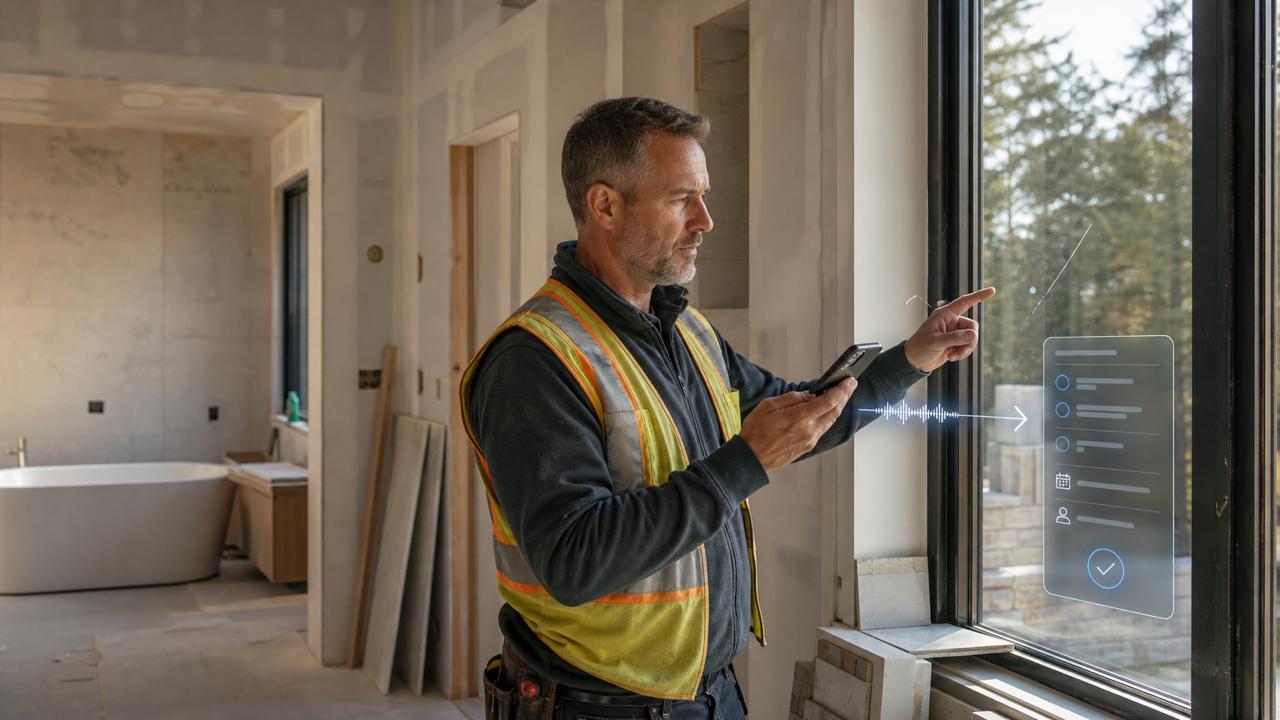
For thirty years, construction software has meant screens. Pages, menus, tables, forms, filters, buttons. The bargain was always the same: if you wanted better information, somebody had to feed the software. The person with the answer - moving through a jobsite, holding a phone, standing in front of the thing that needs to be captured - had to become a data-entry clerk.
That bargain is breaking.
The future of construction software is not another prettier webpage. The future is voice. Talk to your system. Tell it what you need. Let it do the work.
Voice first, interface for review
This doesn't mean screens disappear. Builders still need budget pages. Owners still need reports. Project managers still need to inspect the details before something gets sent, approved, billed, or changed.
The right transition is not voice instead of interface.
The right transition is voice first, interface for review.
Voice is how the work starts. The screen is where the work gets inspected, adjusted, approved, and finalized. Construction is too consequential for black-box automation - budgets, change orders, schedules, and client reports all need control. But control should not require fifteen clicks every time somebody wants to capture a jobsite reality.
The builder says what needs to happen. The system understands it, assembles the draft, shows its work, and waits for approval where approval matters.
That is where BuildTools is going. More importantly, that is where BuildTools already is.
Not a chatbot. A project assistant.
BuildTools Intelligence is not a chat box bolted onto a construction app. It is built into BuildTools and works with live project data: schedules, budgets, photos, documents, invoices, purchase orders, RFIs, submittals, selections, punch lists, daily reports, vendors, clients, compliance records, and more.
It answers questions:
- "What's the budget looking like?"
- "What's overdue on the schedule?"
- "Show me photos of the foundation work."
- "Which document mentions the retaining wall change?"
- "Are any jobs missing yesterday's daily report?"
But the bigger shift is that it gets work done:
- Draft a change order
- Create a purchase order
- Build a daily report
- Prepare a weekly client report
- Preview a schedule change - and everything it would move - before anything is saved
- Queue vendor schedule notifications for approval
- Open a compliance case when a certificate is actually missing
The assistant is not there to be entertaining. It is there to remove friction from real construction workflows.
Voice is not dictation
Dictation turns speech into text. BuildTools Intelligence turns intent into structured construction work.
Say "extra rock excavation, $4,500, unforeseen condition" into a notes field, and you have a note. Say it to BuildTools Intelligence, and you have a draft change order - tied to the right project, with the right title, amount, reason, status, and review path.
Say "windows slipped to Friday," and that detail lands in a daily report draft, connected to the schedule context for the job.
Ask "add two days to tree removal - what would move?" and you get a preview of every downstream task affected - Excavation, Foundation, all of it - computed by the same engine as the Gantt, before anything is saved.
That is where construction software is headed. Not speech-to-text. Work-by-conversation.
This only works with guardrails
There is a cheap version of AI in software: a chat box in the corner that answers generic questions. That is not good enough for construction. A builder does not need software that confidently invents a budget number. A client report cannot be based on vibes.
BuildTools Intelligence runs on three rules:
- It only sees what you can see. Every request runs under the user's permissions. No budget access, no budget numbers.
- It never acts without you. Consequential work is drafted, reviewed, or approval-gated. A change order lands as an unsent draft. A bulk vendor notification goes to an approval queue.
- It does not make up project facts. Every number, date, link, file, and photo comes from actual BuildTools data. If it can't look something up, it says so.
Those rules are what make voice fast and useful instead of dangerous.
The screen becomes the place for judgment
Builders will still use screens - they should. But those screens should increasingly serve judgment, not busywork.
Review the draft. Check the amount. Confirm the affected tasks. Approve the notification. Open the source document.
That is a far better use of human attention than clicking through a system just to create the first version of anything.
AI should do the assembly. People should make the decisions.
This is not a concept video
BuildTools Intelligence works across the whole system - not one module, not a pilot corner of the product. Budgets and schedules. Change orders, purchase orders, invoices. Daily and weekly reports. Documents, photos, RFIs, submittals, punch lists, selections, compliance, time clock, bid packages. Vendors and clients.
Voice and text share one conversation. Start a daily report by voice from the truck; review it later at your desk. Ask for photos of the rough electrical, then follow up with "any showing wire tails, from July?" It knows the project you're viewing, links back to every record it uses, and shows cards, thumbnails, and tables right in the chat.
This is the new operating model for BuildTools.
The builders who adopt this first will feel it
The advantage will not be that AI writes a nicer paragraph.
The advantage is that daily reports get created while the details are still fresh. Punch items get captured while standing in front of the issue. Schedule impacts get previewed before a bad promise gets made. Client reports start from real job activity instead of a blank page. Budget questions get answered without hunting through tabs.
Small moments compound. Less friction means better data. Better data means better decisions. Better decisions protect margin, schedule, and client trust.
That is why voice matters - not because talking to software is novel, but because talking is already how construction teams work.
BuildTools is simply letting the software keep up.
Want to see it on your own projects? Book a walkthrough of BuildTools Intelligence →