
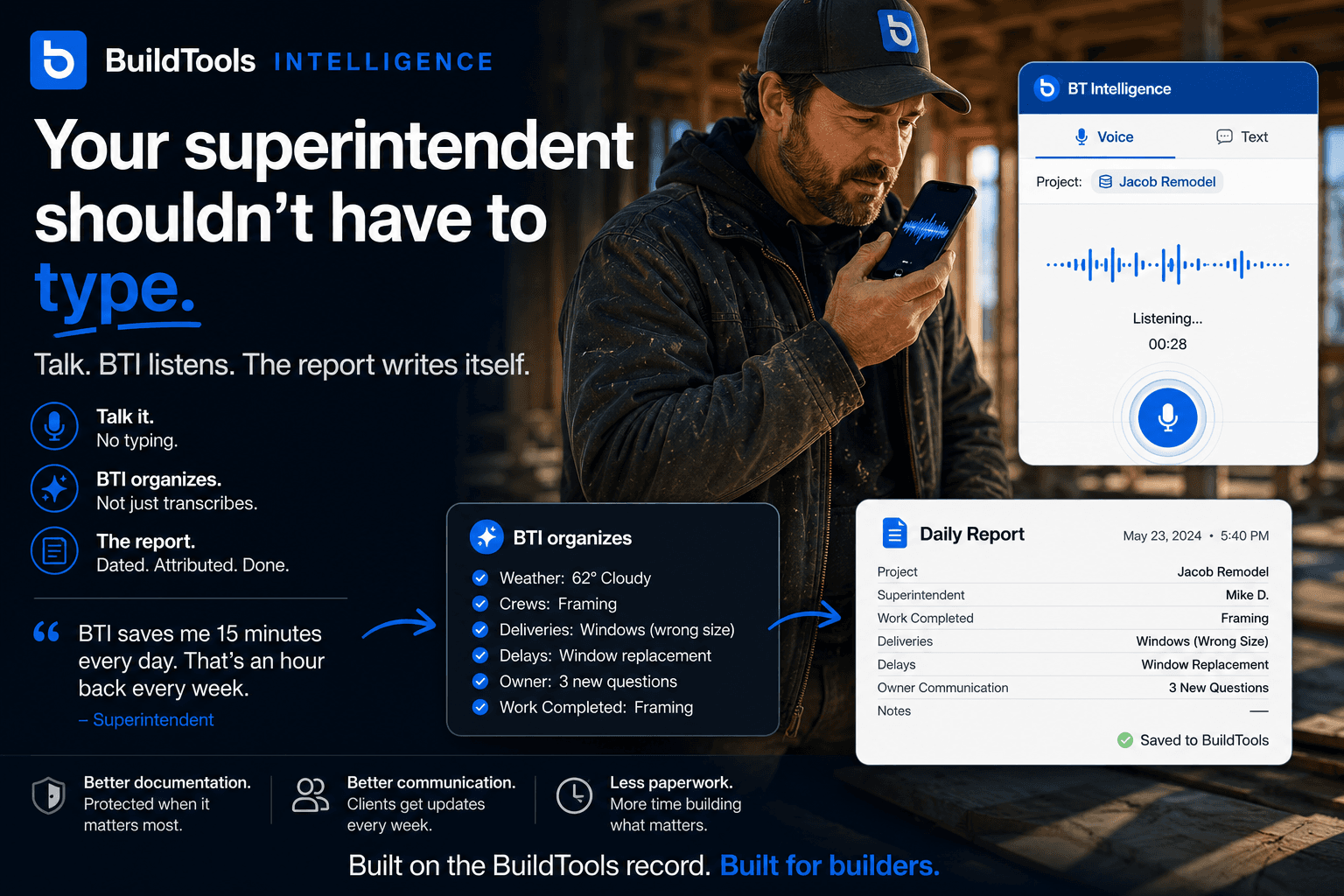
It's 5:40 on a Thursday. The framing crew just left, the windows showed up a day early and in the wrong size, the homeowner stopped by with three new questions, and your super is standing in a half-built great room with mud on his boots and a phone in his hand.
What he's supposed to do now is open an app, tap through a form, and write up the day.
What he actually does is drive home and tell himself he'll do it tomorrow.
We built BuildTools Intelligence for that moment.
Talk to your job site
BuildTools Intelligence (BTI) is the voice layer inside BuildTools. Instead of typing a daily report, your super just talks. He can call in from the truck, walk the site narrating what happened, or fire off a voice note before he pulls out of the driveway. BTI listens, understands the job, and turns what he said into a structured daily report inside BuildTools — dated, attributed, and tied to the right project.
No form. No thumb-typing on a phone in the cold. He talks the way he'd talk to you on the phone, and the report writes itself.
Here's the part that matters: it doesn't just transcribe. BTI organizes. Weather, crews on site, work completed, deliveries, delays, safety notes, conversations with the owner — it pulls the rambling end-of-day brain-dump apart and files it where it belongs. The report that lands in BuildTools reads like a report, not a voicemail.
The report you actually want when things go sideways
Every builder knows that the daily log you skipped is the one you needed. A delay claim, a warranty fight, a "you never told me that" from a homeowner — they all come down to what you can show.
Because BTI makes reporting take thirty seconds instead of fifteen minutes, the reports actually get written. Every day. And because each one is time-stamped and tied to the project record, what you end up with is a clean, contemporaneous account of the job — the kind of documentation that holds up when someone's memory gets creative six months later.
You're not building a paper trail because a lawyer told you to. You're building it because your team will actually do it now.
Friday's client update, handled
Daily reports keep you covered. They don't impress your client — most homeowners don't want to read five field logs full of "set rough plumbing, inspection passed."
So BTI takes the week's reports and writes the email your client does want: a clear, friendly summary of what got done, what's coming next, and anything they need to know or decide. It reads like you sat down Friday afternoon and thoughtfully wrote it yourself. You didn't. You reviewed it, maybe tweaked a line, and hit send.
Custom home clients are paying for a premium experience, and communication is most of what they judge it by. BTI gives them a builder who reports in like clockwork — without adding a single hour to your week.
Built on the BuildTools record, not bolted on
BTI isn't a separate app you have to babysit. It runs on top of the project data already in BuildTools, so a voice report knows which job it belongs to, which client to update, and where it fits in the timeline. The intelligence is connected to the work — that's what makes the output usable instead of just impressive.
Less paperwork, more building
The pitch is simple. Your field team talks instead of types. The reports get written because writing them got easy. The documentation protects you because it's complete and dated. And your clients hear from you every week because the update writes itself.
That's BuildTools Intelligence: the office work that used to pile up, now handled in the time it takes to walk to the truck.