
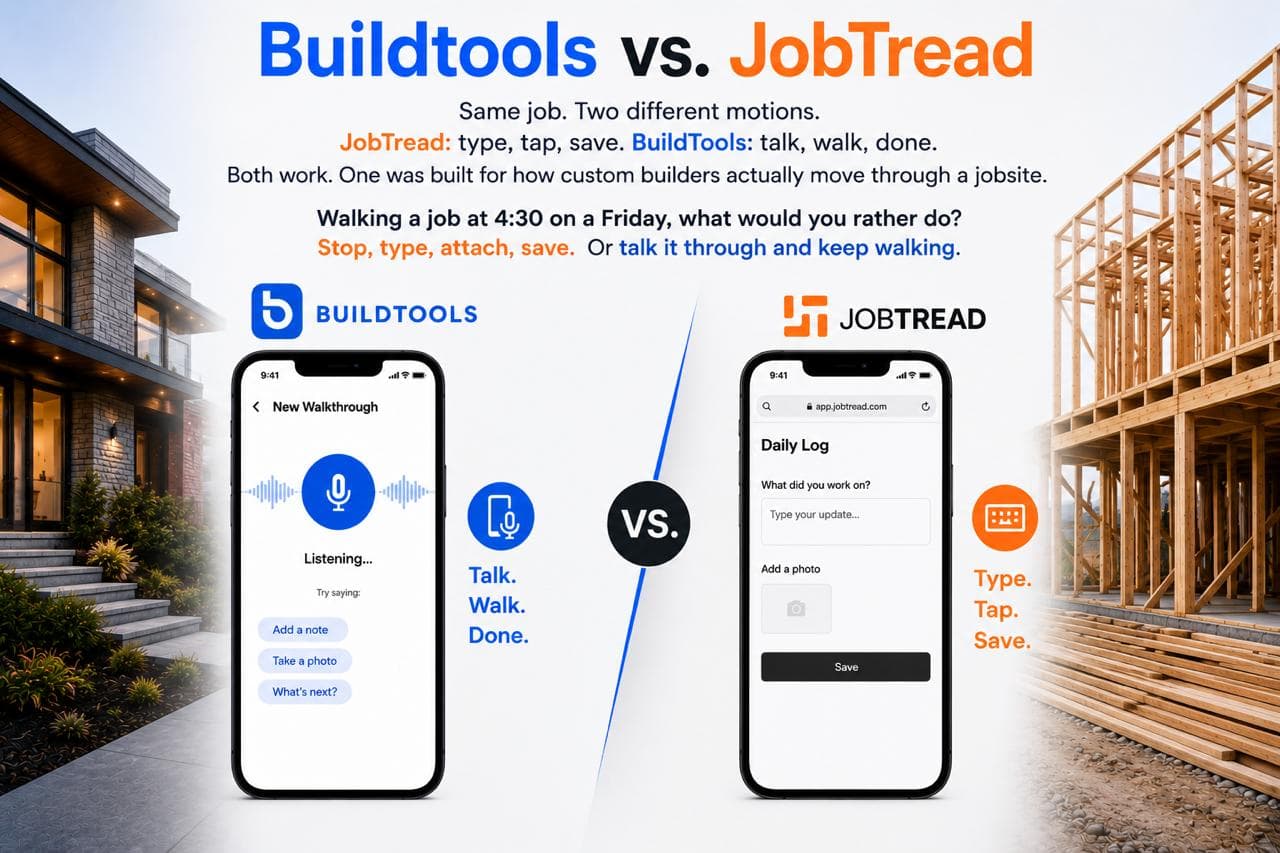
The JobTread vs. BuildTools comparison is different from the Buildertrend, Procore, or CoConstruct comparison.
JobTread is modern software with strong reviews, real growth, and an AI-forward product strategy. They reached 10,000 customers in February 2026 and launched their AI Connector in April 2026, letting customers connect Claude or ChatGPT directly to their JobTread account. They have an Open API that reviewers genuinely love. Their interface is clean. Their support reputation is strong. Their G2 High Performer designation is earned.
This isn't a setup. This is a real comparison.
So this one comes down to a different question than the others. Not "are they modern?" — they are. Not "do they understand AI?" — they do.
The question is what kind of modern, AI-forward platform is actually right for a custom homebuilder.
The short answer
JobTread is built broadly for jobs-based businesses — general contractors, remodelers, electricians, plumbers, custom homebuilders, deck specialists, and more. If you want a polished all-in-one platform with horizontal flexibility and you're comfortable being one of many verticals the company serves, JobTread is a serious option.
BuildTools is built specifically for custom homebuilders and remodelers, with AI built into the foundation of the platform from the rebuild. If you want a platform whose entire reason for existing is to run your kind of business — and whose product roadmap isn't being pulled across plumbers, electricians, and general contractors — BuildTools is the better fit.
Both are honest answers. They're answers to slightly different questions.
What JobTread does well — and credit where it's due
Any fair comparison should start here.
JobTread's product is genuinely good. Pricing is straightforward — $159/month annual or $199/month month-to-month for the first user, with $18–$20 per additional internal user. All features included. Unlimited jobs, customers, vendors. Strong QuickBooks Online integration. An Open API that contractors call "in a league of its own." Reviewers consistently call out interface quality, mobile responsiveness, and the customer success team. Their G2 High Performer designation is earned.
Their AI Connector launch in April 2026 was a smart move. It lets customers connect their JobTread account to Claude or ChatGPT and use those models to query data, create estimates and schedules, review performance, and surface field issues. They've also been weaving AI support across the platform more broadly.
BuildTools doesn't need to pretend JobTread is bad to win this comparison. The honest question is which platform is the better long-term operating system for custom builders specifically.
The first real difference: focus
JobTread is explicitly built for jobs-based businesses broadly. Their materials and reviewer base include general contractors, remodelers, electricians, plumbers, custom home builders, deck specialists, and more. They serve small business through enterprise.
That's a strategic choice. It gives JobTread a much larger market and explains the growth velocity. It's also producing real wins — plenty of custom builders use JobTread successfully today.
It also means every product decision is being weighed across many verticals. When a deck contractor and a custom homebuilder want change orders built differently, somebody compromises. When a plumber and a remodeler need different financial workflows, the platform has to generalize.
BuildTools is the opposite bet. Custom homebuilders and remodelers, specifically. Selections, allowances, change orders, draws, lien waivers, vendor invoices, and client communication — designed around the way those builders actually work, without abstracting across a dozen trades.
Neither bet is wrong. They produce different software over time.
The second real difference: AI architecture
Both platforms are investing seriously in AI. Worth looking at how each is architected — because the architectural choice changes what the daily experience actually feels like.
JobTread layered AI onto a strong existing platform. Their AI Connector is a native integration that connects external models — Claude, ChatGPT — to your JobTread account. You can ask the model questions, pull data, generate estimates and schedules. It's flexible and powerful, and they've been adding AI capabilities across the product more broadly. The strength of this approach is flexibility — you bring your own model, write your own prompts, and connect as your needs evolve.
BuildTools rebuilt the platform from scratch with AI as a foundational design constraint. Rather than adding AI to an existing codebase, the entire platform was rebuilt on a modern stack with AI workflows shaped to custom homebuilding from the ground up.
The clearest place to see that difference is the walkthrough.
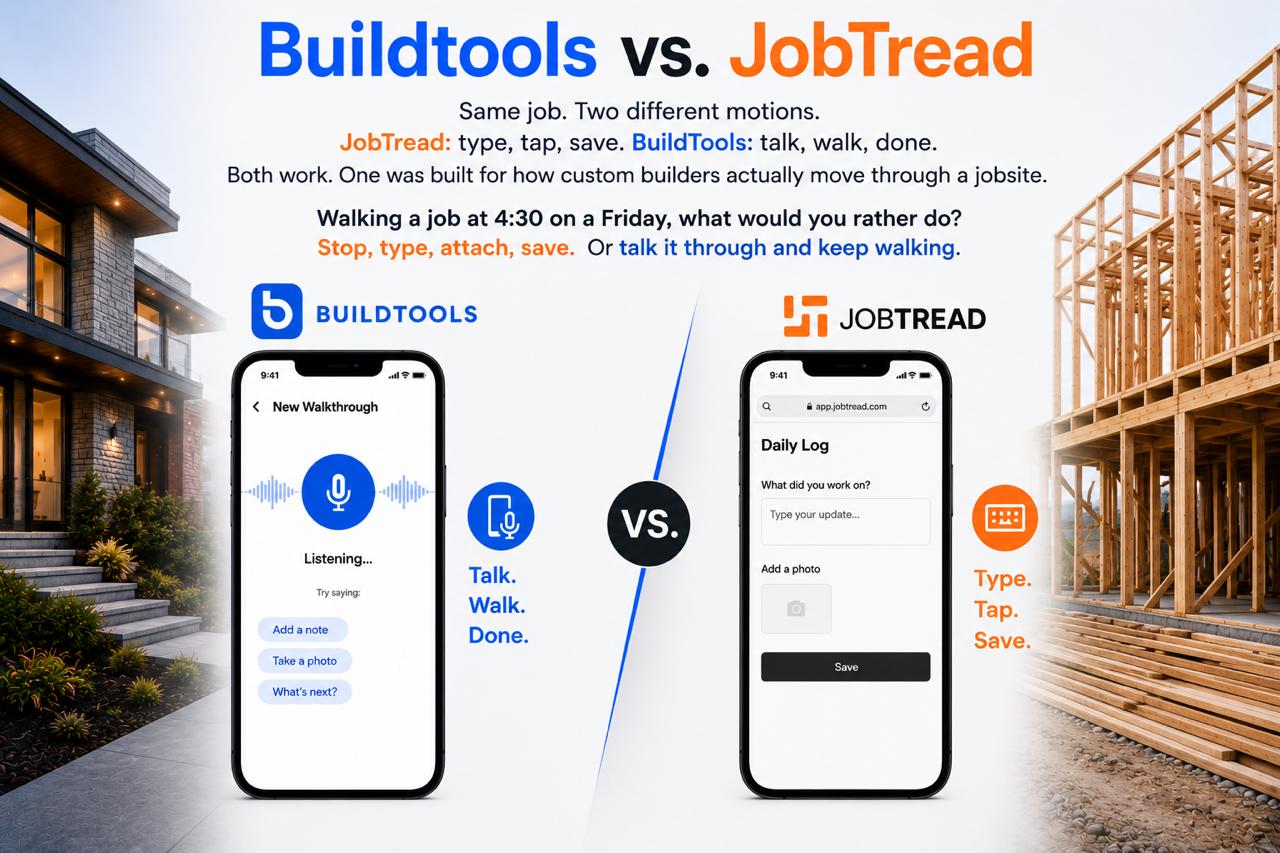
The walkthrough is where the architectural difference shows up in your hands.
JobTread's mobile experience is solid — daily logs, photo capture, task updates. You type your update, attach a photo, hit save. It works.
BuildTools is built for a different motion. You walk the job and talk through what you see. The platform captures notes, generates tasks, builds the punch list, and assembles a client-ready report — from the audio. The thing every super already does on a phone, structured and saved.
Two modern platforms. Two different bets on how a builder actually works in the field.
That same architectural choice — voice-driven, native to the workflow — runs through the rest of the AI surface:
Virtual Project Management. Talk to BuildTools the way you'd talk to a project coordinator. "Create a punch item on the Gillis project for the painter to touch up the trim in the master bedroom. Assign it to Mike. Due Friday." Done. No menus, no typing, no looking at a screen at 4:30 on a Friday.
AI Invoice Processing. Vendor invoices come in, BuildTools reads them, matches them against POs and budgets, flags discrepancies, routes them for approval, and pushes the approved ones into QuickBooks.
AI Bid Review. Drop in three subcontractor bids and BuildTools verifies they match the specs and selections, highlights scope gaps, and shows you which bid is genuinely apples-to-apples.
BuildTools Intelligence. AI-assisted budgets, specifications, and schedules trained on how custom builders actually work.
The JobTread approach gives you flexibility — bring your own model, write your own prompts, integrate as you grow. The BuildTools approach gives you AI workflows already shaped to custom homebuilding, without the engineering work to wire them yourself.
Different philosophies. Different daily experiences.
The third real difference: contract flexibility
A small but practical difference worth knowing.
JobTread offers a no-contract monthly plan ($199/month for the first user) and an annual plan with a 12-month commitment ($159/month). The monthly plan comes with a 30-day money-back guarantee.
BuildTools offers six-month contracts. Less commitment than an annual plan, more stability than month-to-month. It's a builder's contract length — long enough to fully evaluate fit on a real project cycle, short enough that the vendor has to keep earning the relationship.
Neither approach is wrong. They reflect different relationships between vendor and customer.
Built by homebuilders — and that means something specific here
"Built by builders, for builders" gets used loosely in this category. JobTread serves builders well, among many other trades. BuildTools is built specifically by them.
BuildTools was originally founded by Sven Gustafson, a fourth-generation custom homebuilder running Stonewood (founded 1947). He built BuildTools the first time because the software his company needed didn't exist. He sold it to ECI Software Solutions in 2020. Five years later — after watching the platform sit largely static under enterprise ownership while AI rewrote what software could do — he bought it back.
The rebuild is being driven from inside an active custom homebuilding company. The questions that drive the roadmap are custom-builder questions:
- How does a selection affect allowance exposure?
- How does a change order move from field reality to owner approval to accounting?
- How does a draw reflect current job status?
- How are lien waivers handled before payment becomes a problem?
- Will the super actually use this on a phone with one hand — or talk to it without looking at the screen at all?
Those are the questions that produce a custom homebuilder operating system — not a horizontal platform with custom builders as one use case among many.
JobTread vs. BuildTools: where each fits
JobTread may be the right fit if:
- You serve a mix of project types — general contracting, remodeling, specialty trades — and value horizontal flexibility
- You're comfortable being one of many verticals on a fast-growing platform
- Per-user pricing aligns with how you scale your team
BuildTools is the better fit if:
- You're a custom homebuilder or remodeler specifically
- You want AI workflows already built around custom homebuilding — voice-driven walkthroughs, virtual PM, AI invoice processing, AI bid review — without the engineering work to wire them yourself
- You want a platform whose entire roadmap is shaped by your kind of builder, not generalized across trades
- You'd rather work with a builder-led, founder-owned team focused on custom residential
- A six-month contract beats a year-long commitment
The verdict
JobTread is good software. The team has earned the growth they're seeing, and the AI Connector is a real product, not vaporware.
The honest distinction isn't "BuildTools is modern and JobTread isn't." They both are. The distinction is who the platform is built for and how the AI is architected.
JobTread is building a horizontal platform for jobs-based businesses with a flexible AI layer.
BuildTools is building an AI-native operating system specifically for custom homebuilders and remodelers, founder-owned and builder-led.
Same job. Two different motions. If you'd rather talk through a walkthrough than type one, and you want a platform whose entire reason for existing is your business — not your business plus a dozen others — BuildTools is the stronger long-term choice.
If you're searching for a JobTread alternative, don't compare feature checklists. Compare focus and AI architecture.
That's where the real difference lives.